
Vault-LD
An open format for knowledge that two very different readers can share at once:
a person editing notes, and a machine reasoning over a graph.





RDF in the Vault
Karpathy's "LLM wiki" idea points at something real: a directory of plain Markdown notes is one of the most powerful ways to work with LLMs. It is readable by you, chunkable by a model, and diffable in git, with no database required. The YAML frontmatter at the centre of this approach carries a hidden pattern: it can map onto YAML-LD (JSON-LD with a YAML serialization). Resolve that frontmatter through one shared context and your notes stop being tagged text. They become linked data.
This matters for anyone already invested in RDF-based ontologies. Your business semantics (your classes, properties, and controlled vocabularies) drop straight into the wiki your team already uses, much as schema.org gave web pages a shared vocabulary without asking authors to leave HTML. The benefit runs both ways: business semantics arrive inside the wiki, and the ontology gains a human-friendly surface, where classes and properties can be read and edited as notes rather than as raw Turtle.
Both directions work because of the roundtrip. Since the frontmatter is YAML-LD, a note and an ontology definition are the same kind of object, and either can be projected losslessly to RDF and back. An ontology can enter as Turtle, be edited as Markdown, and leave as Turtle again, or the reverse, with no canonical "real" form privileged over the other.
What's here
- SPEC.md: the normative reference. It defines how frontmatter becomes a knowledge graph (§4) and how any RDF graph round-trips through the vault format with full fidelity (§5), along with terminology, directory structure, conformance criteria, and a compatibility profile for lifting OKF-style Markdown bundles into linked data (Appendix B).
Vault-LD Example/: a complete, copyable vault that demonstrates every rule in the spec. It holds one ontology (Culinary), one controlled vocabulary (Difficulty Levels), and one instance (hummus). Its rootcontext.jsonldcomposes the Culinary ontology's own context, showing how multiple contexts compose (SPEC §4.2).scripts/vault_to_rdf.py: a reference exporter that projects a vault to RDF — see Exporting to RDF below.scripts/rdf_to_vault.py: the reference ingester running the other way, RDF → vault — see Ingesting RDF below. Together the two tools close the roundtrip.
Exporting to RDF
The repo ships scripts/vault_to_rdf.py, a small Python tool that reads a vault and emits Turtle, split by layer into two files:
schema.ttl— the schema layer (classes, properties, concepts), each ontology in its own namespace (cul:,diff:, …),data.ttl— the instance layer (typed notes) under the vault base, each IRI minted from the note's vault-relative path.
It classifies each note by its folder, mints each subject under the @base of its governing context (schema notes from their file name, instances from their vault-relative path — SPEC §4.5), resolves frontmatter through the vault's composed @context, and flags anything it can't map rather than dropping it. Export the example vault to build/ in one line:
pip install rdflib pyyaml && python scripts/vault_to_rdf.py "Vault-LD Example" --out-dir build
See EXPORT.md for the full usage guide, flags, and how layer classification and context composition work.
Ingesting RDF
The reverse direction, scripts/rdf_to_vault.py, projects any RDF graph into the vault format (SPEC §5.5) — one note per subject, hierarchy in frontmatter, IRI objects as wiki links. Point it at an existing vault and it updates notes in place, preserving bodies, tags:, and folder structure, and leaving unchanged notes untouched; point it at an empty directory and it builds the whole vault, synthesizing a composed context.jsonld when none exists. Predicates the context doesn't map get a short name coined and added to the right context document; anything the format can't express (blank nodes, language tags) is flagged, never dropped (SPEC §5.6). Import a foreign ontology in one line:
python scripts/rdf_to_vault.py MyVault foreign-ontology.ttl
See INGEST.md for the full usage guide and the fidelity rules. Because the two tools are inverses, vault → RDF → vault is a no-op and RDF → vault → RDF is graph-isomorphic.
A taste
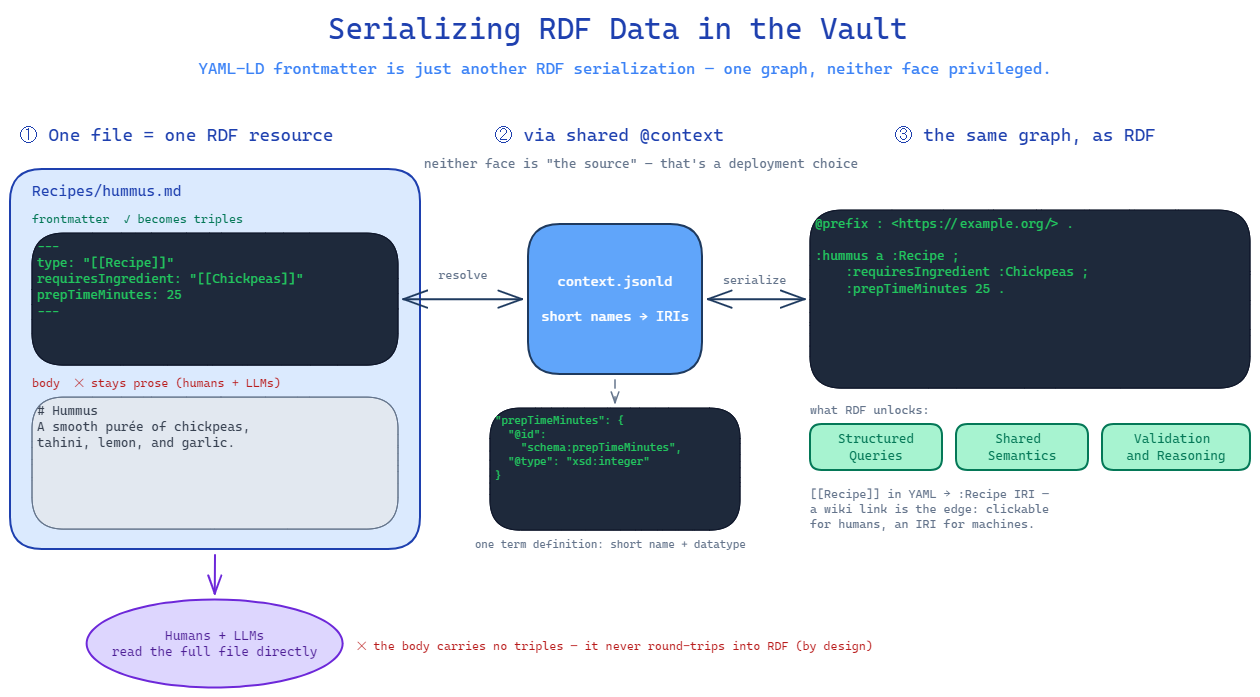
Read this note:
---
type: "[[Recipe]]"
requiresIngredient: "[[Chickpeas]]"
prepTimeMinutes: 25
---

# Hummus
A smooth purée of chickpeas, tahini, lemon, and garlic.
You have just read these triples:
@prefix : <https://example.org/> .

:Hummus a :Recipe ;
            :requiresIngredient :Chickpeas ;
            :prepTimeMinutes 25 .
The frontmatter is the graph; the body is prose for human and machine readers. One shared context.jsonld supplies the IRIs, datatypes, and prefixes, so authors write short, clean names while the semantics are supplied for them. See the Vault-LD Specification for the full rules.
Contributing
Vault-LD is an open standard and contributions are welcome: see CONTRIBUTING.md. Spec changes start life as an issue using the Spec change proposal template; fixes to the reference tools, example vault, and docs can go straight to a pull request.
License
If Vault-LD is useful to you, a ⭐ on GitHub helps others find it.